Mastering the AOR Exam: A Comprehensive Guide to Syllabus, Strategy, and Success
By Vikas Pandey, Advocate, Supreme Court of India
The Advocate-on-Record (AOR) examination is widely regarded as one of the most challenging professional examinations in India. It is the gateway for lawyers to gain the exclusive right to practice before the Supreme Court of India. Passing this exam is not merely a testament to one’s legal knowledge but also to their procedural expertise, ethical grounding, and drafting precision.
Having guided many aspiring advocates through this rigorous process, I have compiled a detailed roadmap based on the latest syllabus and examination patterns. For a more detailed breakdown and access to resources, you can visit my website at www.vikaspandey.co.in. Here, we will dissect the structure, syllabus, and strategic preparation required to conquer the AOR exam.
Understanding the Exam Structure: The 400-Mark Challenge
The first step to success is understanding the battlefield. The AOR exam is a comprehensive assessment spread over four days, totaling 400 marks. It is designed to test not just rote memorization but the application of law in real-world scenarios.
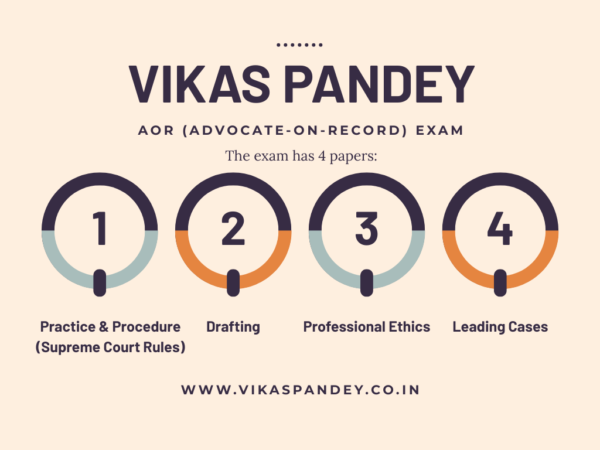
The exam evaluates candidates across four distinct papers:
- Paper I: Practice and Procedure
- Paper II: Drafting
- Paper III: Advocacy and Professional Ethics
- Paper IV: Leading Cases
The evaluation process is stringent, with a focus on accuracy, analytical ability, and adherence to the Supreme Court Rules. Understanding the dates, duration, and mode (which may be offline) is crucial for logistical planning. The passing criteria and scoring system demand a focused strategy, as simply passing each paper individually may not suffice; securing a competitive overall percentage is often key.
What’s New? Key Updates in the 2025 AOR Exam Syllabus
Staying updated with the latest changes is critical. The syllabus for the 2025 AOR examination has introduced some significant updates that every candidate must note:
-
Updated List of 86 Leading Cases: The list of prescribed judgments has been revised. Candidates must now study an updated set of 86 leading cases. These cases form the bedrock of Paper IV and are crucial for building strong arguments in other papers.
-
December 2021 Attempt Exemption Clarification: There have been important clarifications regarding exemptions for those who had attempted the exam around December 2021. It is vital to verify your eligibility and exemption status based on the latest official notifications.
Syllabus Deep Dive: Subject-Wise Analysis
A subject-wise approach ensures that you allocate your time and energy effectively. Here is a detailed look at what each paper entails.
Paper I: Practice and Procedure
This paper is the procedural heart of the exam, focusing on the Supreme Court Rules, the Constitution, and the Code of Civil Procedure (CPC). The questions are structured into three specific categories to test practical knowledge:
- Jurisdiction-Based Questions (40-45% Weightage): This is the most critical section. Questions focus on the Court’s original, appellate, advisory, and special leave jurisdictions. You must be able to identify when and how the Supreme Court can exercise its power.
- Direct Questions from Supreme Court Rules (30-35% Weightage): This tests your memory and understanding of specific rules. Be prepared for questions on caveats, petitions, affidavits, and the procedure for filing appeals.
- Situation-Based Procedural Scenarios (20-25% Weightage): These questions assess your ability to apply the rules to complex, hypothetical situations. For example, you might be given a set of facts and asked to advise on the next procedural step or the appropriate remedy.
Paper II: Drafting
Drafting is an art that requires precision. In this paper, you are not expected to just write; you are expected to draft a legally sound, correctly formatted document that would be acceptable to the Supreme Court Registry.
Types of Questions: Questions may require you to draft a Special Leave Petition (SLP), a Civil Appeal, a Writ Petition (under Article 32), a Transfer Petition, or a Caveat.
How to Approach Drafting Questions: Success in drafting comes from a two-pronged approach:
- Identifying Supreme Court Jurisdiction Issues: Before drafting, you must correctly identify the jurisdiction under which the petition lies. A SLP under Article 136 is fundamentally different from a Writ Petition under Article 32.
- Proper Format and Structure Requirements: The Registry is strict about formats. You must know the prescribed colors for covers (e.g., red for SLPs), the page numbering system, the index structure, and the specific language required for different parts of the petition.
Paper III: Advocacy and Professional Ethics
This paper moves beyond black-letter law to test your professional judgment and ethical compass.
Key Sources: The primary sources for this paper are the Bar Council of India Rules (particularly Chapter II, Part VI on standards of professional conduct) and landmark judgments on professional ethics.
Types of Questions:
- Opinion-Based and Critical Analysis Questions: You may be asked to provide a legal opinion on a set of facts, analyzing the strengths and weaknesses of a client’s case.
- Scenario-Based Ethical Dilemma Questions: These questions present ethical quandaries, such as conflicts of interest, misconduct, or professional negligence. You must decide the correct course of action as per the BCI rules and established precedents.
Paper IV: Leading Cases
This paper tests your in-depth knowledge of the 86 prescribed leading cases. It is not enough to know the names; you must understand the facts, the issues, the ratio decidendi, and the impact of the judgment.
How to Study:
- Subject-Wise Study Approach vs. Chronological Reading: While chronological reading gives historical context, a subject-wise approach (e.g., grouping all Constitutional law cases, all Criminal law cases) is more effective for the exam, as it helps you recall related precedents for specific issues.
- High-Frequency Cases: Focus on cases that are frequently cited in practice, such as those dealing with the scope of Article 142, principles of natural justice, and the parameters of judicial review.
Strategic Preparation Timeline
Your timeline depends on your current level of practice. Here are three recommended strategies.
1. 12-Month Comprehensive Plan (Recommended)
- Months 1-4: Focus on building a strong foundation. Read the Supreme Court Rules and CPC thoroughly. Start reading the 86 leading cases, one per day, with detailed notes.
- Months 5-8: Begin Paper II and Paper III preparation. Practice drafting at least one petition per week. Deepen your analysis of the leading cases.
- Months 9-12: Intensive revision. Take weekly mock tests to meet your benchmarks and simulate exam conditions.
2. 6-Month Intensive Plan
This is for Supreme Court practitioners already familiar with the daily workings of the Court. The focus shifts from learning to perfecting.
- Month 1-2: Master Paper I and the list of 86 cases.
- Month 3-4: Intensive drafting practice and ethics preparation.
- Month 5-6: Daily mock tests and focused revision on weak areas.
3. 3-Month Crash Course (Last Resort)
This approach requires immense dedication and should only be undertaken by those with substantial prior exposure. The focus is entirely on high-yield topics, mock tests, and memorizing key rules and case ratios.
Milestones and Mock Test Benchmarks: Regularly assess yourself. By the final month, you should be able to score over 60% in mock tests for each paper under timed conditions.
Essential Study Resources
Leveraging the right resources can make or break your preparation.
- Supreme Court Official Resources: The Supreme Court Rules, 2013 (and relevant handbooks) are your bibles. Do not rely on secondary sources for rules. The official video lectures and case PDFs available on the Supreme Court website are invaluable.
- Recommended Books: Standard textbooks on Civil Procedure, the Supreme Court Rules, and collections of leading cases are essential.
- Previous Year Question Papers: These are arguably the most important resource. Analyzing common topics based on AOR previous year question papers helps you understand the examiner’s mindset and predict question patterns.
Frequently Asked Questions (FAQs)
Q: Are there any restrictions on the number of attempts to appear for the AOR exam?
A: No, there is currently no restriction on the number of attempts, provided you meet the eligibility criteria.
Q: What are the rules governing re-examination for the exam?
A: Candidates who fail in one or more papers are usually required to reappear in all papers in the subsequent examination. There is no provision to reappear only in the failed papers.
Q: Is the AOR exam syllabus available as a PDF on the Supreme Court website?
A: Yes, the official syllabus and the list of leading cases are available on the official Supreme Court of India website in PDF format. Always refer to the official source for the most accurate information.
Q: Which paper is considered most difficult in the exam?
A: While difficulty is subjective, Paper I (Practice and Procedure) and Paper II (Drafting) are traditionally considered the most challenging due to their high technicality and strict adherence to rules.
Q: Do I need to memorize all Supreme Court Rules for Paper I?
A: You need to have a working knowledge of the entire rulebook, but focus more on the rules related to jurisdiction, filing, appeals, and special leave petitions, as these are the most tested areas.
Q: What is the difference between descriptive and situational questions?
A: Descriptive questions ask you to explain a rule or provision directly. Situational questions present a hypothetical scenario and require you to apply the rules to that scenario, often demanding a more analytical and practical answer.
Q: How much time should I allocate to each paper in my study plan?
A: A balanced approach is key. Allocate roughly 30% of your time to Paper I, 30% to Paper II, 20% to Paper IV, and 20% to Paper III, adjusting based on your strengths and weaknesses.
Q: Are previous year question papers important for understanding the AOR exam syllabus?
A: Absolutely. They are critical for understanding the question patterns, the weightage given to different topics, and the level of detail required in answers.
Q: Should I join coaching classes or can I prepare from the syllabus alone for the exam?
A: This depends on your self-discipline and background. Many have cleared the exam through self-study using the syllabus, rules, and previous year papers. However, coaching can provide structure, feedback on drafting, and peer support.
Q: What are the steps for AOR enrollment after passing the exam?
A: After passing the exam, you must formally apply for enrollment to the Supreme Court, submit the required documents and fees, and take the prescribed oath as an Advocate-on-Record.
Conclusion
Clearing the AOR exam is a monumental achievement that distinguishes you as a specialist in Supreme Court practice. It requires a blend of theoretical knowledge, practical drafting skills, and unwavering ethical integrity.
By following a structured plan based on the detailed syllabus—covering the updated list of 86 cases, the nuances of Paper I, the artistry of Paper II, the ethics of Paper III, and the depth of Paper IV—you can navigate this challenge successfully.
Remember, consistent preparation, regular mock tests, and a thorough understanding of the Supreme Court Rules are your keys to success. For more personalized guidance, resources, and updates, I invite you to visit my website at www.vikaspandey.co.in.
The AOR Exam is a rigorous test of knowledge, drafting skills, ethics, and case law expertise. With the updated 2025 syllabus, candidates must adopt a structured study plan, focus on jurisdictional clarity, and master the 86 leading cases.
Success in this exam is not just about passing—it is about becoming a recognized Advocate-on-Record before the Supreme Court of India
Best Wishes,
Vikas Pandey
Advocate, Supreme Court of India