AOR Exam Syllabus 2025: A Complete Strategic Guide for Aspirants
The Advocate-on-Record (AOR) Examination is one of the most prestigious professional qualifications for advocates aspiring to practice independently before the Supreme Court of India.
Unlike conventional examinations, the AOR exam evaluates not only theoretical knowledge but also practical skills such as drafting, procedural understanding, and professional ethics.
This article presents a comprehensive, structured, and practical guide to the AOR Exam Syllabus 2025, designed to help serious aspirants prepare effectively.
Exam Structure: Marks, Duration & Format
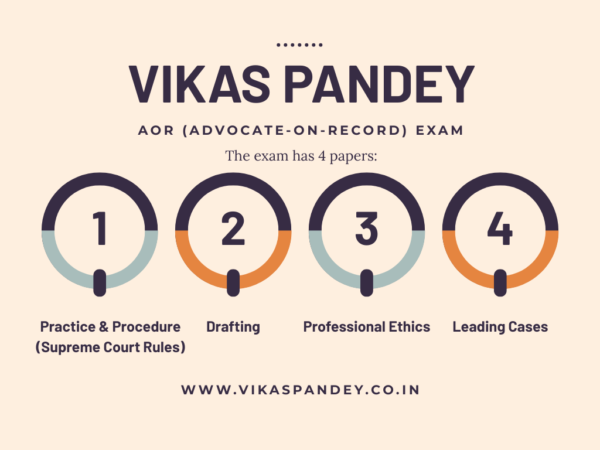
The AOR Examination consists of:
- Four Papers
- Total Marks: 400
- Conducted over 4 consecutive days
- Mode: Descriptive (Offline)
Papers Overview:
- Practice & Procedure
- Drafting
- Advocacy & Professional Ethics
- Leading Cases
Passing Criteria & Evaluation
To qualify:
- Minimum 50% marks in each paper
- Overall, 60% aggregate required
The evaluation focuses on:
- Clarity of legal reasoning
- Practical application of law
- Precision in drafting
What’s New in AOR Exam 2025
Recent updates include:
- Expansion of Leading Cases to 86
- Increased focus on:
- Practical scenarios
- Analytical and application-based questions
- Clarifications regarding December 2021 attempt exemptions
Subject-Wise Syllabus Breakdown
Paper I: Practice & Procedure
Key Areas:
- Constitutional provisions related to the Supreme Court’s jurisdiction
- Supreme Court Rules
- Civil Procedure Code (CPC)
- Procedural laws
Question Pattern:
- Jurisdiction-based: 40–45%
- Direct rule-based: 30–35%
- Situational/procedural: 20–25%
Focus: Practical court procedure and filing knowledge
Paper II: Drafting
Types of Drafts:
- Special Leave Petition (SLP)
- Writ Petition
- Counter Affidavit
- Interlocutory Applications
Approach:
- Identify correct jurisdiction
- Follow Supreme Court format strictly
- Maintain clarity, brevity, and structure
Insight: Drafting is the most decisive paper in the exam
Paper III: Advocacy & Professional Ethics
Key Sources:
- Advocates Act
- Bar Council of India Rules
Question Types:
- Opinion-based questions
- Ethical dilemmas
- Analytical reasoning
Tip: Conceptual clarity can make this a scoring paper
Paper IV: Leading Cases
Updated Coverage:
- 86 Leading Cases
Study Strategy:
- Focus on legal principles (ratio decidendi)
- Prefer subject-wise study over chronological reading
Question Pattern:
- Problem-based application
- Principle identification
Important: Headnotes are provided—focus on understanding, not memorization
Strategic Preparation Timeline
When to Start?
- Ideally 6–12 months before the exam
12-Month Plan (Recommended)
- First 4 months: Bare Acts & Procedure
- Next 4 months: Drafting & Ethics
- Last 4 months: Case laws & revision
6-Month Intensive Plan
- Daily structured study
- Regular drafting practice
- Monthly mock tests
3-Month Crash Strategy
- Focus on:
- Drafting practice
- Important case laws
- Supreme Court Rules
Milestones & Practice Strategy
- Weekly answer writing
- Monthly full-length mock tests
- Regular revision cycles
Essential Study Resources
- Supreme Court Handbook
- Official case law PDFs
- Bare Acts (CPC, Limitation Act, Advocates Act)
- Previous year question papers
- Drafting templates
Common Topics from Previous Exams
- Limitation issues
- Registry objections
- Maintainability of SLP
- Ethical misconduct scenarios
- Constitutional jurisdiction
Frequently Asked Questions
Q. Are there limits on attempts?
No strict limit, subject to eligibility conditions.
Q. Which paper is most difficult?
Drafting (Paper II)
Q. Is memorization required?
No—focus on understanding and application.
Q. Are previous year papers important?
Yes, they are crucial for understanding exam patterns.
Q. Coaching vs self-study?
Both are effective—discipline and practice matter most.
Q. What after passing the exam?
You become eligible to practice independently as an AOR before the Supreme Court.
Conclusion
The AOR Examination is not just an academic test—it is a professional qualification that reflects an advocate’s readiness to practice before the highest court of the country. Success in this exam requires discipline, practical understanding, drafting skills, and consistent revision.
With the right strategy and dedication, clearing the AOR exam is an achievable goal.