AOR Exam Syllabus 2025: Complete Guide for Supreme Court Practitioners
By Vikas Pandey, Advocate, Supreme Court of India
The Advocate-on-Record (AOR) examination is not merely a test of legal knowledge; it is the ultimate rite of passage for any lawyer aspiring to master practice before the Supreme Court of India. As the exclusive gateway to filing cases and representing clients in the highest court of the land, clearing this examination is a career-defining achievement.
Having guided countless legal professionals through this rigorous journey, I have compiled this comprehensive guide to demystify the AOR Exam Syllabus. Whether you are a seasoned Supreme Court practitioner or a diligent advocate taking the first step toward this specialization, this resource—available in detail at www.vikaspandey.co.in—will provide you with the structure, strategy, and confidence needed to succeed.
Understanding the AOR Exam: Structure and Format
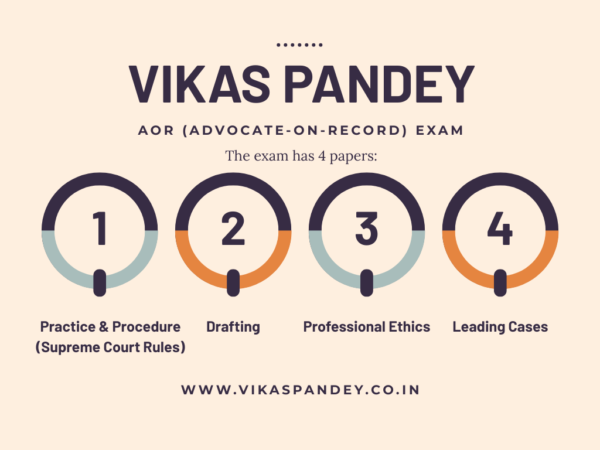
The AOR examination is a carefully crafted, four-day assessment designed to test every facet of Supreme Court practice. It is an offline (pen and paper) examination, conducted at designated venues in New Delhi, with each paper carrying 100 marks, for a total of 400 marks.
The structure is as follows:
- Day 1: Paper I – Practice and Procedure (100 Marks)
- Day 2: Paper II – Drafting (100 Marks)
- Day 3: Paper III – Advocacy and Professional Ethics (100 Marks)
- Day 4: Paper IV – Leading Cases (100 Marks)
Each paper is three hours long. The evaluation is carried out centrally by officials appointed by the Supreme Court, with results typically declared within a few months.
The Passing Criteria: What You Need to Score
To earn the prestigious title of Advocate-on-Record, you must meet a dual-threshold requirement:
Individual Paper Minimum: Score at least 50% in each of the four papers (i.e., a minimum of 45 out of 100 per paper).
Aggregate Minimum: Achieve an overall aggregate of at least 60% across all four papers (i.e., a minimum of 200 out of 400).
There is no negative marking. However, it is important to note that the Supreme Court’s rules regarding “grace passes” for candidates who fail in one or two papers but meet the aggregate are subject to specific guidelines, which you can find in the official notification.
What’s New in the 2025 AOR Exam Syllabus?
Staying updated with the latest changes is non-negotiable for success. The 2025 syllabus has introduced key updates:
Updated List of 86 Leading Cases: The Supreme Court has revised the prescribed list of leading cases to 86. This expanded list forms the bedrock of Paper IV and is essential for building strong arguments in Paper I and III.
December 2021 Attempt Exemption Clarification: There have been important clarifications regarding exemptions for candidates who appeared in the December 2021 attempt. I strongly advise all aspirants to verify their eligibility and exemption status by checking the latest official notification or contacting the Supreme Court Registry.
Syllabus Deep Dive: A Subject-Wise Analysis
A focused, subject-wise strategy is key to mastering the syllabus. Let’s break down each paper.
Paper I: Practice and Procedure
This is the procedural heart of the exam, testing your mastery over the Supreme Court Rules and the Constitution. Questions are designed to assess practical application.
- Constitutional Provisions Covered: You must have a firm grasp of Articles 32, 136, 137, 138, 139, 141, 142, 143, and 145, covering the Court’s original, appellate, and advisory jurisdictions, as well as the scope of judicial review.
- Supreme Court Rules, CPC, and Procedural Laws: A deep understanding of the Supreme Court Rules, 2013 is non-negotiable. You will also be tested on the application of the Code of Civil Procedure, 1908, the Code of Criminal Procedure, 1973, and the Limitation Act, 1963 in the context of Supreme Court proceedings.
How Questions Are Structured:
- Jurisdiction-Based Questions (40-45% Weightage): These are the most critical. They test your ability to determine the correct type of petition (e.g., SLP, Writ, Appeal) under the appropriate Article or provision.
- Direct Questions from Supreme Court Rules (30-35% Weightage): These questions focus on specific rules regarding filing procedures, court fees, format of petitions, and Registry procedures.
- Situation-Based Procedural Scenarios (20-25% Weightage): You will be presented with a hypothetical scenario and asked to identify the correct procedure, limitation period, or appropriate remedy.
Paper II: Drafting
Drafting is an art that demands precision. This paper assesses your ability to create legally sound, formally correct documents that would be accepted by the Supreme Court Registry.
What Types of Questions Are Asked?
You may be required to draft a variety of documents, including:
- Special Leave Petition (SLP) under Article 136
- Writ Petition under Article 32
- Transfer Petition
- Review Petition
- Grounds of appeal in a criminal appeal
- Counter affidavits and interlocutory applications
How to Approach Drafting Questions:
-
Identify the Correct Jurisdiction: Before you write a single word, determine the jurisdictional basis—is this an SLP, a writ, or a statutory appeal? This decision dictates the entire structure.
-
Follow the Mandatory Format: Every draft type has a prescribed format. Pay meticulous attention to the cause title, synopsis, list of dates, grounds, and prayer. Correct formatting is a significant part of the evaluation.
-
Practice, Practice, Practice: Drafting is a skill honed by repetition. Use previous year question papers to practice drafting under timed conditions.
Paper III: Advocacy and Professional Ethics
This paper moves beyond procedure to test your ethical compass and your judgment as a legal professional.
Key Sources:
Your preparation for this paper must be rooted in:
- The Advocates Act, 1961 (Chapters IV and V)
- Bar Council of India Rules (Standards of Professional Conduct and Etiquette)
- AOR Rules governing the conduct of Advocates-on-Record
- Leading case law on professional misconduct, such as Bar Council of India v. A.K. Balaji (2018)
What Types of Questions Are Asked?
- Opinion-Based and Critical Analysis Questions: You may be asked to analyze a factual situation and provide a legal opinion on whether specific conduct constitutes professional misconduct.
- Scenario-Based Ethical Dilemma Questions: These questions present real-world ethical quandaries, such as conflicts of interest, duty to the client versus duty to the court, or the issue of soliciting briefs.
Paper IV: Leading Cases
This paper is the most content-intensive, requiring an in-depth study of all 86 prescribed leading cases. It’s not enough to know the names; you must understand the facts, issues, ratio decidendi, and the impact of the judgment.
How to Study the 86 Leading Cases:
- Adopt a Subject-Wise Approach: Group the cases by subject (e.g., Constitutional Law, Criminal Law, Civil Procedure, Professional Ethics) rather than reading them chronologically. This helps in cross-linking principles and applying them to specific legal issues.
- Create Case Briefs: For each case, prepare a concise note that includes: Case Name, Year, Court, Key Facts, Issue(s), Decision, and the Principle/Ratio Decidendi.
High-Frequency Cases and Question Patterns:
Based on an analysis of previous year papers, you can expect questions that:
- Ask you to identify the case from a brief description of its facts.
- Require you to state the principle of law established by a specific case.
- Present a factual scenario and ask you to apply the principle of a leading case.
- Ask you to distinguish between two leading cases on similar points of law.
Strategic Preparation Timeline
Your preparation strategy must align with your available time. Here are three proven approaches:
1. 12-Month Comprehensive Plan (Recommended)
- Months 1-3: Build a strong foundation by mastering the Supreme Court Rules, 2013, and the key constitutional provisions for Paper I.
- Months 4-5: Study all 86 leading cases, creating detailed briefs and grouping them subject-wise.
- Months 6-7: Focus on Paper II. Practice drafting at least three different documents per week.
- Months 8-9: Dive deep into Paper III, focusing on the BCI Rules and ethical case law.
- Months 10-11: Intense revision, mock tests, and solving previous year question papers.
- Month 12: Take full-length mock exams under exam conditions and consolidate your final revision.
2. 6-Month Intensive Plan (For Supreme Court Practitioners)
- Months 1-2: Parallel study of Paper I (Rules) and Paper IV (Leading Cases).
- Months 3-4: Shift focus to drafting practice (Paper II) and a deep dive into Paper III (Ethics).
- Months 5-6: Aggressive mock tests, targeted revision of weak areas, and solving all available previous year papers.
3. 3-Month Crash Course (Last Resort)
This approach requires immense dedication and should only be undertaken by those with significant prior exposure.
- Prioritize Papers I and IV, as they carry the highest weightage.
- Focus only on high-frequency topics and the most critical cases from the list of 86.
- Dedicate at least one hour daily to drafting practice.
- Attempt every previous year question paper you can find.
Milestones and Mock Test Benchmarks:
- Aim to score 60% or more in Paper I mock tests.
- Complete at least 10 full-length drafts before the actual Paper II.
- Ensure you have covered all 86 leading cases at least three weeks before the exam.
Essential Study Resources and Reference Materials
Leveraging the right resources is critical for efficient preparation.
- Supreme Court Official Resources: Your primary materials should be the AOR Examination Handbook and the Supreme Court Rules, 2013, both available for free on the official Supreme Court of India website. The Court’s official YouTube channel also offers invaluable video lectures on the AOR examination.
- Recommended Books:
- Supreme Court Practice and Procedure – For a deep understanding of Paper I.
- Drafting, Pleading and Conveyancing – Essential for Paper II preparation.
- B.M. Gandhi’s Advocacy – A key resource for Paper III (Ethics).
- M.P. Jain’s Indian Constitutional Law – For constitutional questions in Paper I.
- Previous Year Question Papers: These are arguably the most important resource. They help you understand the question pattern, identify high-frequency topics, and build exam temperament.
Frequently Asked Questions (FAQs)
Q: Are there any restrictions on the number of attempts to appear for the AOR exam?
A: Currently, there are no restrictions on the number of attempts, provided you continue to meet the eligibility criteria. However, always check the latest notification from the Supreme Court Registry for any updates.
Q: What are the rules governing re-examination for the exam?
A: Candidates who fail in one attempt may re-appear. Those who have passed some papers but failed others may be exempt from re-appearing in the passed papers, subject to the Supreme Court’s rules.
Q: Is the AOR exam syllabus available as a PDF on the Supreme Court website?
A: Yes, the AOR Examination Handbook, the syllabus, and the list of 86 leading cases are all available in PDF format on the official Supreme Court of India website.
Q: Which paper is considered most difficult in the exam?
A: Paper I (Practice and Procedure) and Paper IV (Leading Cases) are generally considered the most challenging due to their vast syllabus. Paper II (Drafting) can also be difficult without consistent practice.
Q: Do I need to memorize all Supreme Court Rules for Paper I?
A: You do not need to memorize every rule verbatim, but you must have a thorough, working knowledge of all procedurally important rules, especially those concerning filing, jurisdiction, limitation, and court fees.
Q: What is the difference between descriptive and situational questions?
A: Descriptive questions ask you to explain a legal concept or provision. Situational questions present a fact scenario and require you to identify the correct procedure, remedy, or ethical course of action, testing application rather than rote recall.
Q: How much time should I allocate to each paper in my study plan?
A: A general guideline is to allocate 30% of your time to Paper I, 25% to Paper IV, 25% to Paper II (practice-heavy), and 20% to Paper III.
Q: Are previous year question papers important for understanding the AOR exam syllabus?
A: Absolutely. They are invaluable for understanding the question pattern, identifying high-frequency topics, and building exam temperament.
Q: Should I join coaching classes or can I prepare from the syllabus alone for the exam?
A: While self-study with structured resources is possible, coaching classes can provide access to mock tests, expert guidance, and peer discussion, which can significantly improve your chances of success.
Q: What are the steps for AOR enrollment after passing the exam?
A: After clearing the exam, you must complete one year of training under a designated senior AOR, submit the required documents to the Supreme Court Registry, and pay the enrollment fees as prescribed. For complete, step-by-step guidance, visit www.vikaspandey.co.in.
Conclusion
The journey to becoming an Advocate-on-Record is demanding but immensely rewarding. It requires a disciplined, structured approach that combines rigorous study with practical application. By understanding the updated syllabus, adopting a strategic preparation timeline, and leveraging the right resources, you can navigate this challenge successfully.
Remember, success in the AOR examination is not about memorizing rules and cases in isolation—it is about integrating procedural knowledge, drafting precision, ethical wisdom, and a deep understanding of judicial precedents. I have created this guide to serve as your roadmap.
For personalized guidance, expert mentorship, and additional resources on the AOR Exam Syllabus, please visit my website at www.vikaspandey.co.in. I wish you the very best in your pursuit of this prestigious qualification.
This article is based on information available at www.vikaspandey.co.in
Vikas Pandey | Advocate, Supreme Court of India | www.vikaspandey.co.in