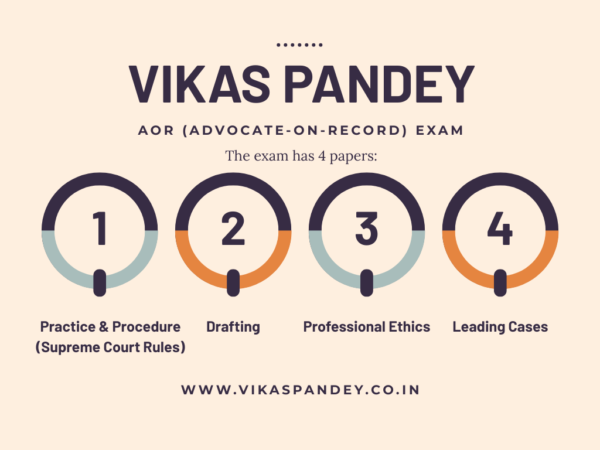
The Complete Guide to the 86 Leading Cases for AOR Exam Paper IV
By Vikas Pandey, Advocate, Supreme Court of India
Table of Contents
- Introduction: Why the 86 Leading Cases Matter
- What’s New in 2025: Expanded List of 86 Cases
- Complete List of 86 Leading Cases with Citations
- Subject-Wise Categorization for Easier Study
- How to Study the Leading Cases Effectively
- Short Notes on Key Cases
- High-Frequency Cases Asked in the Exam
- Frequently Asked Questions
Introduction: Why the 86 Leading Cases Matter
The Advocate-on-Record (AOR) Examination conducted by the Supreme Court of India is the ultimate gateway for lawyers aspiring to practice at the highest level.
Among its four rigorous papers, Paper IV – Leading Cases stands out as the most content-intensive and foundational. It is here that the Supreme Court tests not just your memory, but your understanding of the very bedrock of Indian jurisprudence .
For the 2025 examination, the Supreme Court has significantly expanded the prescribed list from 64 to 86 leading cases . This 34% increase reflects the Court’s intent to ensure that future Advocates-on-Record are well-versed not only in the constitutional pillars of Indian law but also in recent landmark judgments that continue to shape our legal landscape.
These 86 cases are not merely a list to be memorized—they represent the evolution of Indian constitutional, criminal, civil, and administrative law.
Mastering them is essential not just for passing the exam, but for your entire career as a Supreme Court practitioner .
What’s New in 2025: Expanded List of 86 Cases
The Supreme Court has issued an official notification confirming that 22 new cases have been added to the list of leading cases for the AOR Examination. This expansion includes important recent decisions from 2018 to 2024, covering contemporary constitutional developments.
Key Highlights of the Expansion:
Total Cases: Increased from 64 to 86
New Additions: 22 landmark judgments, including recent cases on Article 370, electoral bonds, and other significant constitutional issues
Exam Format: Printed and bound copies of headnotes for these cases will be provided in the examination hall and must be returned after the paper
Important Note for Candidates:
The newly added cases are actively tested in the examination. The Board of Examiners often designs questions specifically around recent additions to ensure candidates stay current with evolving jurisprudence. Do not make the mistake of thinking these new cases might not appear in the first year of inclusion—past patterns show the opposite.
Complete List of 86 Leading Cases (Serial Number Wise)
| S.No. | Case Name | SCR Citation | SCC Citation |
|---|---|---|---|
| 1 | His Holiness Kesavananda Bharati Sripadagalavaru v. State of Kerala | [1973] Suppl. SCR 1 | (1973) 4 SCC 225 |
| 2 | Maneka Gandhi v. Union of India | [1978] 2 SCR 621 | (1978) 1 SCC 248 |
| 3 | Minerva Mills Ltd. & Ors. v. Union of India & Ors. | [1981] 1 SCR 206 | (1980) 3 SCC 625 |
| 4 | Sharad Birdhi Chand Sarda v. State of Maharashtra | [1985] 1 SCR 88 | (1984) 4 SCC 116 |
| 5 | A.R. Antulay v. R.S. Nayak & Anr. | [1988] 1 Suppl. SCR 1 | (1988) 2 SCC 602 |
| 6 | Kihoto Hollohan v. Zachillhu and Others | [1992] 1 SCR 686 | 1992 Supp (2) SCC 651 |
| 7 | Indra Sawhney and Ors. v. Union of India and Ors. | [1992] 2 Suppl. SCR 454 | 1992 Supp (3) SCC 217 |
| 8 | S.R. Bommai and Ors. v. Union of India and Ors. | [1994] 2 SCR 644 | (1994) 3 SCC 1 |
| 9 | L. Chandra Kumar v. Union of India and Others | [1994] 6 Suppl. SCR 261 | (1995) 1 SCC 400 |
| 10 | Vellore Citizens Welfare Forum v. Union of India and Ors. | [1996] 5 Suppl. SCR 241 | (1996) 5 SCC 647 |
| 11 | D.K. Basu v. State of West Bengal | [1996] 10 Suppl. SCR 284 | (1997) 1 SCC 416 |
| 12 | Mafatlal Industries Ltd. v. Union of India | [1996] 10 Suppl. SCR 585 | (1997) 5 SCC 536 |
| 13 | Vishaka and Ors. v. State of Rajasthan and Ors. | [1997] 3 Suppl. SCR 404 | (1997) 6 SCC 241 |
| 14 | Githa Hariharan and Anr. v. Reserve Bank of India and Anr. | [1999] 1 SCR 669 | (1999) 2 SCC 228 |
| 15 | Rupa Ashok Hurra v. Ashok Hurra and Anr. | [2002] 2 SCR 1006 | (2002) 4 SCC 388 |
| 16 | Pradeep Kumar Biswas v. Indian Institute of Chemical Biology | [2002] 3 SCR 100 | (2002) 5 SCC 111 |
| 17 | P. Rama Chandra Rao v. State of Karnataka | [2002] 3 SCR 60 | (2002) 4 SCC 578 |
| 18 | T.M.A. Pai Foundation v. State of Karnataka | [2002] 3 Suppl. SCR 587 | (2002) 8 SCC 481 |
| 19 | P.A. Inamdar v. State of Maharashtra | – | (2004) 8 SCC 139 |
| 20 | Technip SA v. SMS Holding (Pvt.) Ltd. & Ors. | [2005] 1 Suppl. SCR 223 | (2005) 5 SCC 465 |
| 21 | S.B.P. and Co. v. Patel Engineering Ltd. | [2005] 4 Suppl. SCR 688 | (2005) 8 SCC 618 |
| 22 | Rameshwar Prasad & Ors. v. Union of India and Anr. | [2006] 1 SCR 562 | (2006) 2 SCC 1 |
| 23 | I.R. Coelho (Dead) By LRs. v. State of Tamil Nadu | [2007] 1 SCR 706 | (2007) 2 SCC 1 |
| 24 | Common Cause (A Regd. Society) v. Union of India & Ors. | [2008] 6 SCR 262 | (2008) 5 SCC 511 |
| 25 | State of West Bengal v. Committee for Protection of Democratic Rights | [2010] 2 SCR 979 | (2010) 3 SCC 571 |
| 26 | Smt. Selvi & Ors. v. State of Karnataka | [2010] 5 SCR 381 | (2010) 7 SCC 263 |
| 27 | Re: Special Reference No. 1 of 2012 | [2012] 9 SCR 311 | (2012) 10 SCC 1 |
| 28 | Republic of Italy and Ors. v. Union of India and Ors. | [2013] 4 SCR 595 | (2013) 4 SCC 721 |
| 29 | Novartis AG v. Union of India & Others | [2013] 13 SCR 148 | (2013) 6 SCC 1 |
| 30 | Dr. Balram Prasad v. Dr. Kunal Saha & Ors. | [2013] 12 SCR 30 | (2014) 1 SCC 384 |
| 31 | Lalita Kumari v. Govt. of U.P. and Ors. | [2013] 14 SCR 713 | (2014) 2 SCC 1 |
| 32 | National Legal Services Authority v. Union of India | [2014] 5 SCR 119 | (2014) 5 SCC 438 |
| 33 | Pramati Educational & Cultural Trust v. Union of India | [2014] 11 SCR 712 | (2014) 8 SCC 1 |
| 34 | M/s. Kailash Nath Associates v. Delhi Development Authority | [2015] 1 SCR 627 | (2015) 4 SCC 136 |
| 35 | Shreya Singhal v. Union of India | [2015] 5 SCR 963 | (2015) 5 SCC 1 |
| 36 | Supreme Court Advocates-on-Record Association v. Union of India | [2015] 13 SCR 1 | (2016) 5 SCC 1 |
| 37 | Union of India v. V. Sriharan @ Murugan & Ors. | [2015] 14 SCR 613 | (2016) 7 SCC 1 |
| 38 | Gujarat Urja Vikas Nigam Limited v. EMCO Limited | [2016] 1 SCR 857 | (2016) 11 SCC 182 |
| 39 | Mukesh & Anr. v. State for NCT of Delhi & Ors. | [2017] 6 SCR 1 | (2017) 6 SCC 1 |
| 40 | Excel Crop Care Limited v. Competition Commission of India | [2017] 5 SCR 901 | (2017) 8 SCC 47 |
| 41 | Common Cause v. Union of India and Ors. | [2017] 13 SCR 361 | (2017) 9 SCC 499 |
| 42 | Shayara Bano v. Union of India and Others | [2017] 9 SCR 797 | (2017) 9 SCC 1 |
| 43 | Justice K.S. Puttaswamy (Retd.) v. Union of India (Privacy) | [2017] 10 SCR 569 | (2017) 10 SCC 1 |
| 44 | Common Cause (A Regd. Society) v. Union of India & Another | [2018] 6 SCR 1 | (2018) 5 SCC 1 |
| 45 | Municipal Corporation, Ujjain v. BVG India Limited | [2018] 6 SCR 861 | (2018) 5 SCC 462 |
| 46 | Shakti Vahini v. Union of India & Others | [2018] 3 SCR 770 | (2018) 7 SCC 192 |
| 47 | Navtej Singh Johar & Ors. v. Union of India | [2018] 7 SCR 379 | (2018) 10 SCC 1 |
| 48 | Justice K.S. Puttaswamy (Retd.) v. Union of India (Aadhaar) | [2018] 8 SCR 1 | (2019) 1 SCC 1 |
| 49 | Jarnail Singh & Others v. Lachhmi Narain Gupta | [2018] 10 SCR 663 | (2018) 10 SCC 396 |
| 50 | Joseph Shine v. Union of India | [2018] 11 SCR 765 | (2019) 3 SCC 39 |
| 51 | Competition Commission of India v. Bharti Airtel Limited | [2018] 14 SCR 489 | (2019) 2 SCC 521 |
| 52 | Swiss Ribbons Pvt. Ltd. & Anr. v. Union of India & Ors. | [2019] 3 SCR 535 | (2019) 4 SCC 17 |
| 53 | Ssangyong Engineering & Construction Co. Ltd. v. NHAI | [2019] 7 SCR 522 | (2019) 15 SCC 131 |
| 54 | Dr. Ashwani Kumar v. Union of India and Another | [2019] 12 SCR 30 | 2019 SCC OnLine SC 1144 |
| 55 | Rojer Mathew v. South Indian Bank Limited and Ors. | [2019] 16 SCR 1 | (2020) 6 SCC 1 |
| 56 | CPIO, Supreme Court of India v. Subhash Chandra Agarwal | [2019] 16 SCR 424 | (2020) 5 SCC 481 |
| 57 | Committee of Creditors of Essar Steel India Limited v. Satish Kumar Gupta | [2019] 16 SCR 275 | (2020) 8 SCC 531 |
| 58 | M/s Shanti Conductors Private Limited v. Assam State Electricity Board | [2019] 16 SCR 252 | (2020) 2 SCC 677 |
| 59 | Keisham Meghachandra Singh v. The Hon’ble Speaker, Manipur | [2020] 2 SCR 132 | 2020 (2) SCALE 329 |
| 60 | Sushila Aggarwal and Others v. State (NCT of Delhi) | [2020] 2 SCR 1 | (2020) 5 SCC 1 |
| 61 | Dheeraj Mor v. Hon’ble High Court of Delhi | [2020] 2 SCR 161 | (2020) 7 SCC 401 |
| 62 | Internet and Mobile Association of India v. Reserve Bank of India | [2020] 2 SCR 297 | (2020) 10 SCC 274 |
| 63 | Indore Development Authority v. Manoharlal and Others | [2020] 3 SCR 1 | (2020) 8 SCC 129 |
| 64 | Madras Bar Association v. Union of India & Anr. | [2020] 2 SCR 246 | 2020 (13) SCALE 443 |
| 65 | Nandini Sundar v. State of Chhattisgarh | [2011] 8 SCR 1028 | (2011) 7 SCC 547 |
| 66 | Arnesh Kumar v. State of Bihar | [2014] 8 SCR 128 | (2014) 8 SCC 273 |
| 67 | Abhiram Singh v. C.D. Commachen | [2017] 1 SCR 158 | (2017) 2 SCC 629 |
| 68 | Neeraj Dutta v. State (NCT of Delhi) | [2022] 5 SCR 104 | (2023) 4 SCC 731 |
| 69 | Sukhpal Singh Khaira v. State of Punjab | [2022] 10 SCR 156 | (2023) 1 SCC 289 |
| 70 | Satender Kumar Antil v. CBI | [2022] 10 SCR 351 | (2022) 10 SCC 51 |
| 71 | Janhit Abhiyan v. Union of India | [2022] 14 SCR 1 | (2023) 5 SCC 1 |
| 72 | Shilpa Sailesh v. Varun Sreenivasan | [2023] 5 SCR 165 | (2023) 14 SCC 231 |
| 73 | Kaushal Kishor v. State of U.P. | [2023] 8 SCR 581 | (2023) 4 SCC 1 |
| 74 | Subhash Desai v. State of Maharashtra | [2023] 8 SCR 857 | (2024) 2 SCC 719 |
| 75 | Cox & Kings Ltd. v. SAP India (P) Ltd. | [2023] 15 SCR 621 | (2024) 4 SCC 1 |
| 76 | Interplay B/w Arbitration Agreements under Arbitration Act, 1996 & Stamp Act, 1899, In re | [2023] 15 SCR 1081 | (2024) 6 SCC 1 |
| 77 | Article 370 of the Constitution, In re | [2023] 16 SCR 1 | 2023 SCC OnLine SC 1647 |
| 78 | Association for Democratic Reforms (Electoral Bond Scheme) v. Union of India | [2024] 2 SCR 420 | (2024) 5 SCC 1 |
| 79 | Kavita Kamboj v. High Court of Punjab & Haryana | [2024] 2 SCR 1136 | (2024) 7 SCC 103 |
| 80 | Sita Soren v. Union of India | [2024] 3 SCR 462 | (2024) 5 SCC 629 |
| 81 | State (NCT of Delhi) v. BSK Realtors LLP | [2024] 5 SCR 1159 | (2024) 7 SCC 370 |
| 82 | Mineral Area Development Authority v. SAIL | [2024] 7 SCR 1549 | (2024) 10 SCC 1 |
| 83 | State of Punjab v. Davinder Singh | [2024] 8 SCR 1321 | (2025) 1 SCC 1 |
| 84 | Aligarh Muslim University v. Naresh Agarwal | – | 2024 SCC OnLine SC 3213 |
| 85 | Property Owners Association & Ors. v. State of Maharashtra & Ors. | [2024] 11 SCR 1 | 2024 SCC OnLine SC 3122 |
| 86 | Tej Prakash Pathak v. High Court of Rajasthan | [2024] 12 SCR 28 | (2025) 2 SCC 1 |
Subject-Wise Categorization
Constitutional Law – Basic Structure & Fundamental Rights
| S.No. | Case Name |
|---|---|
| 1 | Kesavananda Bharati v. State of Kerala |
| 3 | Minerva Mills Ltd. v. Union of India |
| 8 | S.R. Bommai v. Union of India |
| 23 | I.R. Coelho v. State of Tamil Nadu |
| 43 | Justice K.S. Puttaswamy v. Union of India (Privacy) |
Fundamental Rights – Article 21 & Personal Liberty
| S.No. | Case Name |
|---|---|
| 2 | Maneka Gandhi v. Union of India |
| 11 | D.K. Basu v. State of West Bengal |
| 26 | Selvi v. State of Karnataka |
| 31 | Lalita Kumari v. Govt. of U.P. |
| 60 | Sushila Aggarwal v. State (NCT of Delhi) |
| 66 | Arnesh Kumar v. State of Bihar |
Reservation & Social Justice
| S.No. | Case Name |
|---|---|
| 7 | Indra Sawhney v. Union of India |
| 49 | Jarnail Singh v. Lachhmi Narain Gupta |
| 71 | Janhit Abhiyan v. Union of India |
| 83 | State of Punjab v. Davinder Singh |
Criminal Law & Procedure
| S.No. | Case Name |
|---|---|
| 4 | Sharad Birdhi Chand Sarda v. State of Maharashtra |
| 5 | A.R. Antulay v. R.S. Nayak |
| 39 | Mukesh v. State of NCT of Delhi (Nirbhaya) |
| 68 | Neeraj Dutta v. State (NCT of Delhi) |
| 69 | Sukhpal Singh Khaira v. State of Punjab |
| 70 | Satender Kumar Antil v. CBI |
Women’s Rights & Social Reform
| S.No. | Case Name |
|---|---|
| 13 | Vishaka v. State of Rajasthan |
| 14 | Githa Hariharan v. RBI |
| 42 | Shayara Bano v. Union of India (Triple Talaq) |
| 50 | Joseph Shine v. Union of India (Adultery) |
| 65 | Nandini Sundar v. State of Chhattisgarh |
LGBTQ+ Rights
| S.No. | Case Name |
|---|---|
| 32 | National Legal Services Authority v. Union of India (NALSA) |
| 47 | Navtej Singh Johar v. Union of India (Section 377) |
Commercial Law, Arbitration & IBC
| S.No. | Case Name |
|---|---|
| 20 | Technip SA v. SMS Holding |
| 21 | S.B.P. and Co. v. Patel Engineering |
| 38 | Gujarat Urja Vikas Nigam Ltd. v. EMCO Ltd. |
| 52 | Swiss Ribbons Pvt. Ltd. v. Union of India |
| 53 | Ssangyong Engineering v. NHAI |
| 57 | Committee of Creditors of Essar Steel v. Satish Gupta |
| 75 | Cox & Kings Ltd. v. SAP India (P) Ltd. |
| 76 | Interplay B/w Arbitration Agreements, In re |
Election Law & Anti-Defection
| S.No. | Case Name |
|---|---|
| 6 | Kihoto Hollohan v. Zachillhu |
| 22 | Rameshwar Prasad v. Union of India |
| 59 | Keisham Meghachandra Singh v. Speaker, Manipur |
| 74 | Subhash Desai v. State of Maharashtra |
Environmental Law
| S.No. | Case Name |
|---|---|
| 10 | Vellore Citizens Welfare Forum v. Union of India |
| 46 | Shakti Vahini v. Union of India |
Taxation & Economic Legislation
| S.No. | Case Name |
|---|---|
| 12 | Mafatlal Industries Ltd. v. Union of India |
| 82 | Mineral Area Development Authority v. SAIL |
Right to Information & Transparency
| S.No. | Case Name |
|---|---|
| 56 | CPIO, Supreme Court v. Subhash Chandra Agarwal |
Property & Land Acquisition
| S.No. | Case Name |
|---|---|
| 34 | Kailash Nath Associates v. DDA |
| 63 | Indore Development Authority v. Manoharlal |
Professional Ethics & Judiciary
| S.No. | Case Name |
|---|---|
| 36 | Supreme Court AOR Association v. Union of India (NJAC) |
| 64 | Madras Bar Association v. Union of India |
| 79 | Kavita Kamboj v. High Court of Punjab & Haryana |
| 86 | Tej Prakash Pathak v. High Court of Rajasthan |
Recent Constitutional Developments (2022-2024)
| S.No. | Case Name |
|---|---|
| 71 | Janhit Abhiyan v. Union of India (Maratha Reservation) |
| 73 | Kaushal Kishor v. State of U.P. |
| 77 | Article 370 of the Constitution, In re |
| 78 | Association for Democratic Reforms v. Union of India (Electoral Bonds) |
| 80 | Sita Soren v. Union of India (MP/MLA Bribery) |
| 81 | State (NCT of Delhi) v. BSK Realtors LLP |
| 84 | Aligarh Muslim University v. Naresh Agarwal (Minority Status) |
| 85 | Property Owners Association v. State of Maharashtra |
Key Statistics
| Category | Count |
|---|---|
| Total Cases | 86 |
| Original Core Cases (Pre-2022) | 64 |
| Newly Added Cases (2022-2024) | 22 |
| Constitutional Law Cases | ~25 |
| Criminal Law Cases | ~15 |
| Commercial/Arbitration Cases | ~12 |
| Social Justice Cases | ~10 |
Important Notes for Candidates
- SCR Citations are Preferred: In the AOR Examination, citing cases with their SCR (Supreme Court Reports) references is considered the gold standard. Memorize the SCR citations for landmark cases.
- Headnotes Provided in Exam: Printed and bound copies of headnotes for these 86 cases will be provided in the examination hall and must be returned after the paper.
- New Cases are Actively Tested: The newly added cases (S. Nos. 65-86) are likely to feature prominently in the examination. Pay special attention to recent constitutional developments.
- Subject-Wise Study Recommended: Group cases by subject matter for better retention and cross-referencing.
- Focus on Ratio Decidendi: Examiners test your understanding of the legal principle established, not merely the facts of the case.
Subject-Wise Categorization for Easier Study
To make your preparation more effective, I recommend grouping these cases by legal subject rather than studying them chronologically . Here’s a suggested categorization:
Constitutional Law (Basic Structure & Judicial Review)
- Kesavananda Bharati v. State of Kerala
- Minerva Mills Ltd. v. Union of India
- Indira Nehru Gandhi v. Raj Narain (if included)
- I.R. Coelho v. State of Tamil Nadu
Fundamental Rights & Personal Liberty
- Maneka Gandhi v. Union of India
- Justice K.S. Puttaswamy v. Union of India (Privacy)
- D.K. Basu v. State of West Bengal
- Selvi v. State of Karnataka (Narco-analysis)
Reservation & Social Justice
- Indra Sawhney v. Union of India (Mandal Case)
- M. Nagaraj v. Union of India (if included)
- Jarnail Singh v. Lachhmi Narain Gupta
Federalism & Centre-State Relations
- S.R. Bommai v. Union of India
- State of West Bengal v. Committee for Protection of Democratic Rights
Criminal Law & Procedure
- Sharad Birdhi Chand Sarda v. State of Maharashtra
- Lalita Kumari v. Govt. of U.P.
- Arnesh Kumar v. State of Bihar (if included)
- Mukesh v. State of NCT of Delhi (Nirbhaya)
Women’s Rights & Social Reform
- Vishaka v. State of Rajasthan
- Shayara Bano v. Union of India (Triple Talaq)
- Githa Hariharan v. RBI
- Joseph Shine v. Union of India (Adultery)
LGBTQ+ Rights
- Navtej Singh Johar v. Union of India
- National Legal Services Authority v. Union of India (NALSA)
Commercial & Arbitration Law
- Swiss Ribbons Pvt. Ltd. v. Union of India (IBC)
- Committee of Creditors of Essar Steel v. Satish Gupta
- SBP and Co. v. Patel Engineering
- Technip SA v. SMS Holding
Environmental Law
- Vellore Citizens Welfare Forum v. Union of India
- M.C. Mehta cases (if included)
How to Study the Leading Cases Effectively
Based on my experience guiding AOR aspirants, here is a proven methodology for mastering the 86 leading cases:
1. Create Case Briefs for Each Case
For every case, prepare a concise note covering :
- Case Name & Citation (both SCR and SCC)
- Key Facts (the factual background that led to the case)
- Legal Issue(s) (the core question before the Court)
- Decision & Ratio Decidendi (the binding legal principle)
- Significance (why this case matters in Indian jurisprudence)
2. Use the Subject-Wise Approach
Grouping cases by subject helps you cross-link principles and understand how different cases interrelate. For instance, understanding how Maneka Gandhi expanded Article 21 helps contextualize subsequent cases like D.K. Basu and Puttaswamy .
3. Focus on the Ratio, Not Just the Facts
Examiners test your understanding of the legal principle established by a case, not just its factual background. You should be able to:
State the principle of law from a given case
Apply that principle to a new factual scenario
Distinguish between two similar cases
4. Pay Attention to Official SCR Citations
In the AOR exam, citing cases with their SCR references is considered the gold standard. Memorize the SCR citation for landmark cases—this demonstrates your familiarity with official sources .
5. Practice Answer Writing
The Leading Cases paper requires written responses. Practice writing case briefs and analytical answers under timed conditions. This will help you structure your thoughts efficiently during the exam .
Short Notes on Key Cases
Here are concise notes on some of the most frequently tested cases:
Kesavananda Bharati v. State of Kerala [1973] Suppl. SCR 1
Principle: Established the Basic Structure Doctrine—Parliament cannot alter the “basic structure” of the Constitution under Article 368.
Significance: The most important case in Indian constitutional history. It limits the amending power of Parliament and preserves the core ideals of the Constitution, including judicial review, federalism, secularism, and democracy .
Maneka Gandhi v. Union of India [1978] 2 SCR 621
Principle: Article 21 (right to life and personal liberty) cannot be taken away without a procedure that is fair, just, and reasonable. It read Articles 14, 19, and 21 together, creating a holistic approach to fundamental rights.
Significance: Revolutionized Indian jurisprudence by expanding Article 21 to include due process. This case forms the basis for countless subsequent judgments on personal liberty .
Indra Sawhney v. Union of India [1992] 2 Suppl. SCR 454
Principle: Upheld 27% reservation for Other Backward Classes (OBCs) in central government jobs. Introduced the “creamy layer” concept and capped reservations at 50%.
Significance: The foundational judgment on OBC reservation policy that continues to shape affirmative action in India .
S.R. Bommai v. Union of India [1994] 2 SCR 644
Principle: The power of the President to impose President’s Rule under Article 356 is subject to judicial review. Secularism and federalism are part of the basic structure.
Significance: Curbed the arbitrary misuse of Article 356 and strengthened the federal structure of the Constitution .
Vishaka v. State of Rajasthan [1997] 3 Suppl. SCR 404
Principle: Laid down binding guidelines to prevent sexual harassment of women at the workplace, invoking international conventions and fundamental rights under Articles 14, 19, and 21.
Significance: A pioneering case in judicial activism that led to the enactment of the Sexual Harassment of Women at Workplace Act, 2013 .
D.K. Basu v. State of West Bengal [1996] 10 Suppl. SCR 284
Principle: Issued 11 guidelines to prevent custodial torture and deaths, emphasizing the protection of Article 21 rights in custody.
Significance: Mandated accountability of police officials and established procedural safeguards for arrested persons .
I.R. Coelho v. State of Tamil Nadu [2007] 1 SCR 706
Principle: Laws placed in the Ninth Schedule after April 24, 1973 (the date of Kesavananda Bharati) are open to judicial review if they violate the Basic Structure.
Significance: Strengthened the Basic Structure doctrine and limited the protection offered by the Ninth Schedule .
Justice K.S. Puttaswamy (Retd.) v. Union of India [2017] 10 SCR 569
Principle: Unanimously declared that the Right to Privacy is a fundamental right under Article 21 of the Constitution of India.
Significance: A landmark judgment that affects a wide range of issues from state surveillance to LGBTQ+ rights and data protection .
Navtej Singh Johar v. Union of India [2018] 7 SCR 379
Principle: Decriminalized consensual homosexual acts between adults by striking down part of Section 377, IPC, as violative of Articles 14, 15, 19, and 21.
Significance: A historic victory for LGBTQ+ rights in India, affirming the dignity and identity of the community .
Shayara Bano v. Union of India [2017] 9 SCR 797
Principle: Declared the practice of instant triple talaq (talaq-e-biddat) unconstitutional and void as it violated Articles 14, 15, and 21.
Significance: A major reform for the rights of Muslim women, leading to the legislation of the Muslim Women (Protection of Rights on Marriage) Act, 2019 .
Swiss Ribbons Pvt. Ltd. v. Union of India [2019] 3 SCR 535
Principle: Upheld the constitutional validity of the Insolvency and Bankruptcy Code, 2016 (IBC) in its entirety.
Significance: Provided stability and certainty to the corporate insolvency resolution process in India, affirming the primacy of financial creditors .
High-Frequency Cases Asked in the Exam
Based on an analysis of previous year question papers, certain cases appear more frequently than others :
Constitutional Law (Most Frequent)
Kesavananda Bharati (Basic Structure)
Maneka Gandhi (Article 21 expansion)
Indra Sawhney (Reservation policy)
S.R. Bommai (Article 356)
Minerva Mills (Basic Structure reaffirmed)
Criminal Law
D.K. Basu (Custodial violence guidelines)
Sharad Birdhi Chand Sarda (Circumstantial evidence)
Lalita Kumari (Mandatory FIR registration)
Social Justice & Rights
Vishaka (Sexual harassment guidelines)
Navtej Singh Johar (Section 377 decriminalization)
Shayara Bano (Triple Talaq)
Puttaswamy (Right to Privacy)
Professional Ethics
Supreme Court AOR Association v. Union of India (NJAC/Collegium)
Bar Council of India v. A.K. Balaji (if included)
Commercial Law
Swiss Ribbons (IBC validity)
Essar Steel (IBC implementation)
Frequently Asked Questions
Q1: What is the significance of the 86 leading cases in the AOR Exam?
These judgments reflect the evolution of Indian constitutional and criminal jurisprudence. They help assess a candidate’s ability to understand legal reasoning, precedent, and judicial interpretation. These cases are indispensable for Paper IV and also inform answers in Paper I and III.
Q2: Do I need to memorize all 86 cases?
You need to have a thorough understanding of all 86 cases, but you don’t need to memorize every word. Focus on:
The ratio decidendi (legal principle)
Key facts that establish the context
The SCR citation
How the case applies to practical scenarios
Q3: Are the headnotes provided in the exam?
Yes. During the examination, printed and bound copies of the headnotes for these cases will be provided to candidates in the exam hall. However, these must be returned after completion of the paper, and candidates are instructed not to mark or underline them .
Q4: Which cases are most frequently tested?
Constitutional law cases like Kesavananda Bharati, Maneka Gandhi, and Indra Sawhney are consistently tested. Criminal law cases like D.K. Basu and Sharad Birdhi Chand Sarda also appear frequently. The newly added cases for 2025 are likely to feature prominently.
Q5: How should I organize my study of these cases?
I recommend a subject-wise approach rather than chronological reading. Group cases by legal domain (Constitutional Law, Criminal Law, Commercial Law, etc.) to better understand their interconnections and applications.
Q6: What question patterns appear in the Leading Cases paper?
Typical questions include:
“Identify the case from the following facts.”
“State the principle of law established in [case name].”
“Apply the principle of [case name] to this factual scenario.”
“Distinguish between [Case A] and [Case B]”
Q7: Are recent cases included in the 86?
Yes. The 2025 expansion includes important recent judgments up to 2024, including cases on Article 370, electoral bonds, and other contemporary constitutional developments.
Q8: How much time should I allocate to studying the 86 cases?
Given the expansion to 86 cases, I recommend allocating at least 2-3 months exclusively for Paper IV preparation. Study 2-3 cases per day, creating brief notes for each, and then revise subject-wise.
Conclusion
The 86 leading cases prescribed for the AOR Examination are more than just an academic requirement—they are a profound journey through India’s evolving legal landscape.
From the foundational Basic Structure doctrine in Kesavananda Bharati to the transformative Right to Privacy in Puttaswamy, from criminal jurisprudence in D.K. Basu to social reform in Navtej Singh Johar, these cases represent the collective wisdom of India’s highest judiciary.
Mastering these cases is not just about passing an exam—it is about joining the elite legal discourse that shapes justice in India. As you prepare for Paper IV, remember that each case you study adds to your professional arsenal, equipping you to argue effectively before the Supreme Court of India.
For more resources, guidance, and updates on the AOR Exam, visit my website at www.vikaspandey.co.in. I wish you the very best in your preparation.
Vikas Pandey
Advocate, Supreme Court of India
www.vikaspandey.co.in
Disclaimer: This article is based on information available from official Supreme Court notifications and reliable sources. Candidates are advised to verify the complete and updated list of 86 leading cases from the official Supreme Court of India website.